Showing posts with label tv. Show all posts

Monday, 1 August 2016

Super Nerds

Super Nerds is a failed sitcom pilot from 2000, starring Patton Oswalt as a guy named Leslie who works in a comic shop. There's also a guy named Gayle who doesn't work there, but is there all day anyway, and the shop's owner: an insane immigrant from some vaguely soviet country who's obsessed with money and business. The other main character is Gwen (played by Sarah Silverman), Leslie's childhood friend who just moved back to town and inexplicably has a crush on him.

I'm not really familiar with Patton Oswalt's work, but he seems to be pretty popular with a certain kind of Funko Pop-collecting "nerd culture" types, and watching this, I can see why. It's like if The Big Bang Theory was made a decade earlier. Easy references to things everyone knows like Star Trek, Star Wars and Spider-man's origin being treated as jokes on their own, along with tired old cliches about overweight nerds at conventions in ill-fitting costumes and male nerds being unable to talk in the presence of a woman. There's even a part where a character gets angry to the point of yelling when someone suggests characters from the Marvel and DC universes meeting up.

Being a pilot, I can forgive some of the problems the show has, like the audience sounding as if its made up of about ten people, and the plot obviously being little more than a set up for future shenanigans, but the biggest crimes that Super Nerds commits are unforgivable for a sitcom: it's never funny and all the characters are boring. Another way in which it's similar to The Big Bang Theory! There's been plenty of failed pilots that I've watched and wished the show got made, but Super Nerds definitely isn't one of them.

Sunday, 22 May 2016

Strange Dawn

Although it's mostly forgotten now, this show actually got an English dub and even aired in the UK during that brief, glorius period when every major TV channel needed at least one dubbed anime series in its schedule. Oddly, that dub (which I think was made in/for Australia) seems to be totally unavailable nowadays, through means both legal and otherwise. It's odd that the dub was even made under those circumstances, though, airing as it did in an early morning Saturday morning kids' slot. I can only assume that some comissioner at Channel 5 just looked at the misleadingly-cute promotional art for the series, assumed it was a cute, light-hearted adventure series and then bought it without actually watching an episode. The reason I think this is that it's a pretty serious low fantasy series with bloody violence, war, death and politics and an attempted rape early in the series.

At its most basic, the premise is one seen in quite a few shows of the 90s and early 00s: two schoolgirls (Yoko and Eri) suddenly find themselves in a fantasy world in the midst of war, where they're heralded as prophecised saviours. The catch is that they really are just two normal girls, with no latent special powers or anything. However, the world in which they find themselves is inhabited by little potato-looking people, only about 20cm high. So by default the two girls are significantly larger and stronger than everyone around them, which makes them seem like mighty heroes, even if they aren't. There's also the fact that most of the little people believe that they're holy saviours prophecised to end the war one way or another, giving any side they align themselves with a massive psychological advantage over their foes.

Back when it aired on TV, I didn't think very highly of Strange Dawn. It looked like a boring show with silly-looking spud-people, annoying protagonists and lots of time spent with characters sitting around being sad. Watching again as an adult, I'm enjoying it a lot more: there's fantasy political intrigue, Yoko and Eri each have different, but equally believable reactions to their strange situation (and very different personalities in general), and the cute SD character designs actually serve to make the violence, horror and general seriousness of the series' events seem more serious and shocking, simply through the dissonance between the events and the visuals.

As I write this, I'm still a few episodes from the end, but unless it takes a sudden and dramatic downfall in the episodes to come, I can say I'd definitely recommend Strange Dawn to those wanting a serious fantasy cartoon with an unusual twist.

Wednesday, 2 March 2016

Bishoujo Kamen Poitrine, Episode 1

Bishoujo Kamen Poitrine is a superhero show from 1990, created by the legendary Shotaro Ishinomori. It's a lot lighter in tone than the works for which he's usually known, though, being part of Toei's "Mystery Comedy Series." On her way to school on the first day back after the new year holidays, Yuko visits the local shrine, and by chance meets a strange old man for magic powers. For no obvious reason, the old man tells her she should fight against crime and injustice, and gives her the power to turn into the eponymous superheroine, Poitrine. Later that day, her younger brother goes to the local videogame store to buy the latest Dragonball Z game (really!), where he also hears of a local rumour about the Phantom Videogame Thief, a weird goblin-like thing dressed like Sherlock Holmes, that stuns people with a cattleprod and steals their Famicom cartridges.

Obviously, he later falls victim to that very same thief, though since he's out of the room at the time, doesn't get shocked. Somehow, this all culminates in a showdown between the Phantom Thief and Poitrine in some kind of industrial wasteland, where after a very short fight, the thief's identity is revealed, Scooby Doo-style, and everyone gets their games back.

It's a cute, silly little show, and you know I'm always going to be at least a little biased in favour of live-action Japanese action shows from the 80s and early 90s, so I definitely recommend giving it a look. Unfortunately, there's only one subbed episode available, having been released on the 1st of April, 2015, a day that will live in infamy.

On that day, a few weird old shows had their first episodes subbed as "April Fools" jokes by various groups, most notably (because they were shows I've been wanting to see for a long time) this one and the original Taiketsu Lionmaru. Oh well, hopefully someone'll pick up these shows in the future, and either way, one episode is better than nothing, which a fair few of my wishlist shows still have. And the tokusatsu subbing scene is a lot better than it was ten or even just five years ago! Luckily, though, this episode doesn't end on any kind of cliffhanger, so you can watch it on its own with no problems.

Wednesday, 10 February 2016

Dark Towers

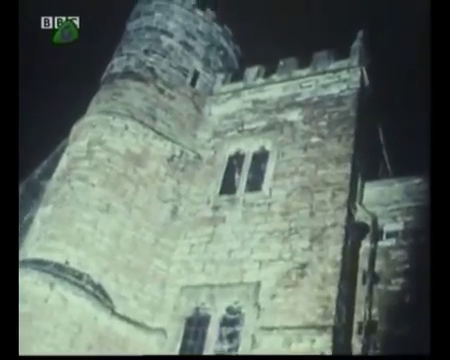
Not to be confused with Stephen King's long-running post-apocalyptic magic cowbay saga, Dark Towers is a 1981 educational TV series aimed at primary schoolchildren. It's about two shabbily-dressed teenage misanthropes (Tracy, who likes dogs better than people, and Edward, the latest Lord Dark, who likes books better than people) overcoming their sexual tension long enough to solve clues and meet ghosts in the hopes of saving Edward's family home, the eponymous castle Dark Towers from two camp conmen and their henchwoman who hope to steal away the castle's antiques and burn it down.

You might wonder why anyone would bother watching a decades-old educational show, and there are really two reasons. The most obvious is nostalgia: though it was made and broadcast years before I (and, I assume most of my readership) was born, it was still being watched on tape at british primary schools well into the mid-90s, at the very least, along with most of the other Look and Read series that had been going since the early 1970s. Luckily for any adult viewers, some helpful soul by the name of malvolio80 has uploaded the series to Youtube with all but one of the awful educational sections mercifully excised. From what I remember, those parts were so slow and simplistic to be useless even when my age was in single figures, and I can only imagine how tedious and annoying they'd be to an adult viewer.

The other reason is the aesthetic: a dusty old castle full of books and ghosts, mystery-solving teenagers in shabby hand-me-down jumpers and master criminals that drive around in a knackered old van. The makers can't have known at the time, but Dark Towers is almost perfect as a simple introduction to some of the basic concepts of hauntology and late 20th century british folk-horror. Obviously, it's not only a childrens' show, but one made to be shown in schools, so the horror elements aren't particularly strong, and the budget is very low, but the look, the feel and the general ambience of the series work well.

You won't really be missing out on a great deal if you don't watch Dark Towers, but I assume it'll at least have some nostalgic value for most British readers, and it's not a terrible show either (in its edited form, at least). For anyone else interested in British kids' horror, something that skews a bit older in its target audience, like The Owl Service, Chocky, or Elidor, might be a better choice.

Tuesday, 19 January 2016

Chokkyuu Hyoudai Robot Anime Straight Title

Chokkyuu Hyoudai Robot Anime Straight Title, also known simply as Straight Title Robot Anime, is a comedy anime that aired in early 2013. The animation was made using the freeware program MikuMikuDance, giving the show a look reminiscent of a low budget third party Dreamcast game. Thousands of years into the future, mankind is extinct and sentient robots wage endless war against each other, for reasons long since forgotten. Three non-combat robots seek to end the war by rediscovering the lost human art of comedy. In an odd bit of bait-and-switch, the show's opening sequence is all-action, showing battle scenes from the endless robot war.

Each episode is split into three segments, the first of which has the three protagonists Fuji, Kato and Mori standing in the post-apocalyptic wasteland, discussing a certain kind of comedy (for example, one-liners, puns, sarcasm, et cetera), and trying to come up with their own examples to try and make each other laugh. The humour in these segments mainly stems from the concept that's at the heart of the show: the characters are robots and as such, none of them has a sense of humour. Even if any of them could understand comedic concepts well enough to successfully make a joke, none of the others would be able to find it funny. So it's a kind of anti-comedy, where you get to enjoy terrible, nonsensical jokes totally falling flat.

The second segment, and by far the weakest, sees the three heroines using a computer simulation to see if the war could be ended by changing the conditions of the world to make things more comedic. So in each episode we see the opening animation again, only this time, all the robots are dizzy, or the entire world is coated in lubricant, or all the guns make farting noises. It's okay I guess, but the show would have been better off losing it.

The final, and by far, the best segement has the robots attempting to perform prop-based improvisational comedy. The great thing about these segments is that they do seem to actually have been improvised by the voice actresses, who are constantly corpsing and struggling to stay in character throughout. There's also moments when they'll make references to things that the other two just don't get and will try and explain the reference while also pretending to be a robot living millenia after the fall of man.

Straight Title Robot Anime instantly became one of my favourite comedy anime once I sat down and watched it, and the fact that it seems to have been ignored by most anime fans (and most of the ones who did watch it obviously didn't get it) shouldn't put you off. Don't bother watching the laugh-free final episode, though.

Thursday, 17 December 2015

Kamen Tenshi Rosetta

Kamen Tenshi Rosetta is a thirteen episode long superhero show from 1998. It aired at 1:30am (or 25:30, as Japanese TV schedules would put it), so it's safe to say it was aimed squarely at an otaku audience. It was also subbed in that interim period in the history of fansubs, after the decline of VHS, but before the rise of Bittorrent, when fansubs were distributed on DVD-Rs and VCDs. This, coupled with the fact that western tokusatsu fandom was still very small, made getting ahold of it in 2015 slightly more difficult than usual. It centres around a teenage girl, Jin Asuka, who learns one night three important things: firstly, humanity is being preyed upon by demons called "Dueltos", her salaryman dad Kenichiro is an egyptian-themed superhero named Jin Kamen Pharoan, and the ankh charm he gave her long ago is magic and allows her to become a superhero herself, Kamen Tenshi Rosetta.

From this premise, the show spends most of its run as a typical monster-of-the-week affair, with a bit of Buffy the Vampire Slayer-esque angst towards the start, as Asuka never asked for her powers or destiny and so on. It doesn't even get a main villain until the last few episodes, just individual monsters that turn up, do evil stuff and get defeated. The show's writers were obviously big fans of Sailor Moon, too, as some of the plots feel very similar to the weekly monster plots in that show. In fact, there's an episode early on that's almost the exact same premise as a Sailor Moon episode: a mysterious audition looking to cast teenage girls is actually a front for an evil monster that wants to eat the girls. Rosetta's version of the plot is a little darker, though, as rather than audition for a TV drama, it's heavily implied to be an audition for porn, or at the very least, something seedy and unwholesome.

Kamen Tenshi Rosetta is generally somewhat darker in tone than most modern Japanese superhero shows, especially ones with female leads. But don't misunderstand: it's not bogged down in gritty drama and edgy grimness, in fact, it's got a lot of quite silly humour, even right up to the final battle. It's just that it feels a little less safe, the streets seem a little dirtier, the shadows a little darker than the usual. But like I said, it's never too dark, it's never depressing, and there's always some lovably terrible Japanese comedy round the corner to lighten the mood.

The action scenes are not bad, about as good as to be expected from a late-night low budget TV show. The worst thing I can really say about them without feeling like I'm being unfair is that a lot of the fight scenes take place in dark locations, and are shot quickly and often from a bit of a distance. Obviously, this is a decision the makers made to try and hide any weaknesses in the effects and monster suits, and it doesn't look too bad when you're watching the show, but it does make it harder to take cool screenshots of the fights to put in blog posts about the show!

All in all, Kamen Tenshi Rosetta is a pretty good show. It's nothing special, and it doesn't have the knowing winks to the camera that more recent otaku-targeted TV shows have, but it's a decently entertaining superhero show with a good balance of action, drama and comedy..

Tuesday, 8 September 2015

Dragon League Episodes 1 & 2

So, before I get into the specific details of this show, I want to talk about the concept of "6AM Cartoons": a specific kind of cartoon defined more by a vague feling than anything else. Basically, the kind of cartoon that would be picked up cheaply, usually dubbed into english from Japanese or French and broadcast in the UK or US at 6AM, with no accompanying merchandising push or promotion of any kind, in those countries at least. Stuff like Sandokan, Spiff and Hercules, Albert the Fifth Musketeer, Ulysses 31 (at least when I saw it in the 90s, anyway) and so on. Even Sailor Moon was one of these shows at some point in its history! Anyway, though it has no english dub (as far as I'm aware, these two fansubbed episodes are all that's been translated into english at all), Dragon League definitely has the feel of a 6AM cartoon.

It's a sports anime, though it eschews the usual modern Japanese school setting for a medieval fantasy kingdom, where humans live alongside animal-people and dinosaur-people, and also actual dinosaurs. Obviously, football is very important in this kingdom, to the point where the equivalent of the knights of the round table are the national football team, led by a huge lion-man. The main character is a young boy named Tokio and his dad used to be on that team, but apparently there's some kind of old grudge between him and the aforementioned lion, Leon.

This cumulates when Tokio and his dad return to the city, and his dad has a "duel" with Leon. Of course, the duel is a one-on-one football match using a magic golden ball. Dad loses, and as a result is turned into a tiny dragon, but he can still talk and stuff so I guess it's okay? The next day, Tokio sees some teams of youngsters roughly his own age (though it's hard to tell, since none of them are human) having a practice game inside the castle grounds, and since one team is a player short, he joins in. The team he joins is terrible, and they're playing against a team of skilled bullies.

By the end of the first half, Tokio's team are losing, but only by 10 goals, where they're apparently down by 40 by this point in most matches. But then, disaster strikes! Tokio is arrested by a castle guard for trespassing and taken to the dungeon. He then has to escape using a combination of football skills and general mischief before half-time is over to finish the game.

Unfortunately, this is where episode 2 ends, so we don't get to see the outcome of the match. So, Dragon League isn't any kind of great hidden gem or anything, but it's an inoffensive little show, and though the concept is pretty strange, you can't help but be surprised you haven't seen it done before. It's also surprising to find that there's apparently no videogame adaptation at all, not even a Japan-only one. There's something about it that just screams "Super Famicom licenced game".

Saturday, 22 August 2015

Tank Top Fighter

Tank Top Fighter is a 2013 TV vehicle for ex-AKB48 member Erena Ono. I guess it wasn't a very successful one, since she retired from showbusiness in 2014, at the grand old age of 20 years old. In it, she plays a college student named Kai, whose father is arrested and jailed for murder and embezzlement (though thanks to the only subs available being fairly below par, the amount he stole seem to change every time it's mentioned. Was it 100 million yen or 10 thousand million yen? Who knows?), but the families of the victims say they'll allow him to be freed if they're paid back the amount that he stole. Is that really a legal thing in Japan? Because it sounds absurd.

Anyway, since she's a college student, and her sister works part time as a computer programmer, there's no way they have that kind of money. But the victims' lawyer tells them they can make the money back by collecting bounties on the heads of various wanted criminals. It's not a particuarly original premise, but it works. The stories, which are typically 2 episodes long, are about Kai and her sister finding their current quarry, through investigation and athletics. That is, there are a lot of scenes with Erena Ono running and climbing over things, whether she's chasing a criminal or just trying to get somewhere quickly, she does a lot of running.

When she does catch the criminal, there's a fight scene, and while these should be the main draw of the show (since they're at the end of each story, and all), they're not that great. I mean, they're okay, but they're nothing special, and I've seen better fights in plenty of other low budget Japanese TV shows. The show's not a complete bust without them, however: the plots are interesting enough, both the individual cases and the overarching plot revolving around Kai's dad and his alleged crime, and there's plenty of twists too. Though some of the twists aren't exactly shocking, for example, I don't feel like it's too big a spoiler to reveal that her dad's actually the victim of a grand villainous conspiracy. The show also has its lead as a draw: Erena Ono is a very cute girl-next-door type, and like I said, the show is mainly about her running about, solving crimes and fighting, which is nice.

I wouldn't really recommend going out of your way to hunt this show down and watch it, but if it ever somehow falls into your lap, there's definitely worse shows to watch. I have one final note before ending this review: there's some comic relief in the show in the guise of two bumbling police detectives. They aren't important or even involved in the main plot at all, though, and the fansubbers don't even bother subbing their scenes at all after the second episode.

Monday, 27 July 2015

The Other Side - Human Furry Animals

I first saw this documentary when it aired back in 2000, and since at the time, I'd had no internet access, and the infamous CSI episode, as well as the various more salacious and exploitative furry documentaries hadn't aired yet (or if they had, I hadn't seen them), this was the first time I'd ever heard of furries as a subculture. Looking at it now, it's actually very different to the modern-day stereotypes of furry culture: there's no fursuits on display, only at the most face and bodypaint, and ears and tails. Furthermore, rather than simply looking in from a distance, the bulk of the documentary is spent on long, personal interviews with a few furries, and the sexual aspect of the subculture is touched upon, but it's far from the focus.


Instead, furries are shown to be pretty much just like any other subculture outside of the mainstream, just a group of disparate people brought together by a common interest. Though, it is mentioned that there's a higher than average proportion of LGBT members in the community, and we do see a lot more men onscreen than women, too, and also everyone in the documentary is white. I don't know if this was representative of the furry scene as it was in London at that time, if it just happened to be whoever was present when the cameras were, or even if there were people who didn't want to be filmed, though.

As I've already mentioned, the sexual and fetishistic aspects of the subculture are only touched upon briefly, and with more respect towards the subjects than most later documentaries would afford, but a great deal is made of tactility. The way furry material feels against the skin, the fact that furries do a lot of hugging, scratching, biting and other physical interactions when meeting in person is talked about a fair bit. Sounds pretty nice, to be honest, though I can imagine that some less socially adjusted members of the subculture would probably cause problems by overreaching people's boundaries (this possibility isn't mentioned at all, though. Maybe it hadn't happened at any of this group's meets? I don't know).

There's also an interview with someone from a sub-subculture of "weres", who believed that he was a wolf in a human's body. I guess in modern internet parlance, this person would be considered Otherkin? This segment made me feel a little uncomfortable, as the interviewee talked a lot about their innermost feelings, and the way they perceive the world through the senses of a wolf, and it all felt a little bit voyueristic. Only a little bit, though, and it doesn't put a damper on what's otherwise a nice little documentary. When I did get internet access the following year, I was surprised to learn how vilified furries were online, it seemed odd to me that people would get so angry about those nice people from the doc i watched.

Wednesday, 6 May 2015

Environmental Superhero Ecogainder

Ecogainder is a low-budget tokusatsu TV series, and while this usually means a weird late night show made specifically for an adult audience, in this case, it's actually an educational show aimed at kids. Ecogainder himself is an android sent from the future to educate the people of 21st century earth about preserving the environment, though he seems to focus all his efforts on one middle class Japanese family. The villains, trying to tempt this same family into wasting energy and not recycling are the Eco Crushers, Mudaana (played by AKB48's Sayaka Akimoto) and Hakais, who are working under the orders of Queen Deathgaia.

Mudaana and Hakais are the most interesting characters in the show, as the Suzuki family are just generic "everyman" types, and Ecogainder himself barely has a personality at all, beyond giving environmental advice. They're based on the old Doronbo Gang archetypes started by Yatterman and seen in a ton of shows and comics and videogames since, though they're missing a fat guy, having only the attractive woman and skinny guy parts of the trio. Hakais is a pretty good example of exactly how low the budget for this show was, as the weapon he wields is clearly just a plastic Doctor Octopus arm toy, not even modified or repainted.

What's interesting about those two is how their relationship with the Suzukis changes over the course of the series. A typical episode sees a member of the family thoughtlessly doing something that's mildly environmentally unsound, like forgetting to recycle, or leaving the TV on standby, at which point the Eco Crushers will turn up and aggressively state how great it is that the family are helping the cause of environmental destruction. Then Ecogainder shows up, and the three of them go off to the "battlefield", which is some kind of big white tent thing, and Ecogainder shoots his ecology beam and the Eco Crushers are banished away.

But over time, the Suzuki family's reaction to the Eco Crushers changes: at first, they're scared and confused when Mudaana and Hakais show up to harass them, over time, they treat the villains as a mild nuisance, and the series' big turning point is a few episodes from the end, when the kids are bored and turn the heating up specifically to summon Mudaana and Hakais so they have more people to play cards with.

I'm sure I'm not spoiling anything when I reveal that in the last episode, Mudaana and Hakais turn against Queen Deathgaia and help Ecogainder in the final battle. It's predictable, but still nice. Ecogainder is definitely no must-watch series, but it's only fourteen nine-minute episodes, so if you really need to see a cheap superhero show, this one isn't too painful. Be warned though, that the series focuses mainly on comedy and educational value, with pretty much no real action on offer.
This series is also known as Kankyou Choujin Ecogainder